Premier Sommet international – feuille de route pour un meilleur avenir du vieillissement
RTOERO’s first Future of Aging Summit, sponsored by Johnsons Inc., brought together more than 200 participants from a range of public sector and non-profit organizations, including RTOERO members, to share knowledge and envision what we need to do today for a better future of aging.
The event provided the chance to learn together from 14 globally recognized aging experts from nine countries and share ideas and experiences through a co-design session to map out concrete actions that will create a better future of aging for all.
Key areas of focus for a better future of aging
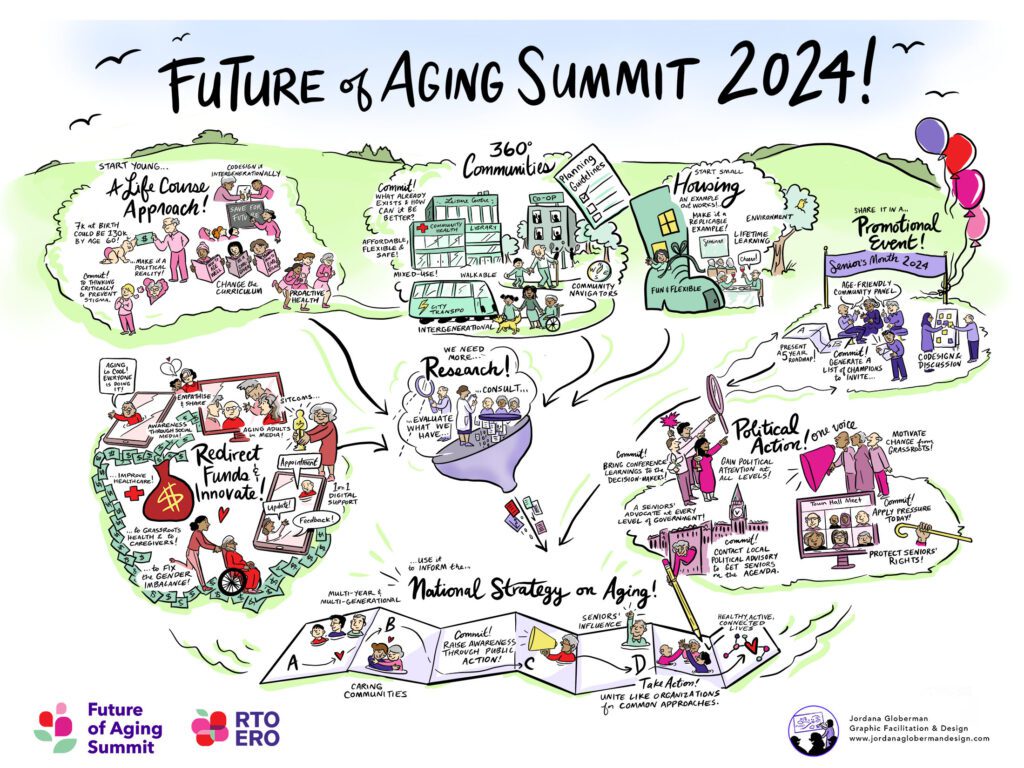
Dreaming big is critical to reimagine a bright future. The co-design session took participants through a series of activities to arrive at visions and commitments, which were captured by Jordana Globerman, a graphic facilitator. The graphic summarizes the ideas of a diverse group of professionals working in planning, community programs, healthcare and more, as well as older adults with experiential knowledge navigating the current systems.
Take a life-course approach
- Start young to ensure healthy aging.
- Integrate healthy aging concepts into the curriculum.
- Encourage intergenerational connections.
- Promote proactive health measures throughout life.
Read more:
Why we need to take a life-course approach to healthy aging
Create 360° communities
- Develop age-friendly communities.
- Plan and design walkable, mixed-use neighbourhoods.
- Encourage lifelong learning and active lifestyles.
- Use community navigators to support aging populations.
Innovate for better housing options
- Start with small-scale projects for impact.
- Promote affordable, flexible, and safe housing options.
- Implement age-friendly housing models.
- Engage in community-wide efforts for better living environments.
Build awareness
- Use events like Seniors Month to raise awareness.
- Engage communities with panels, discussions, and activities.
- Promote age-friendly community initiatives and champions.
Take political action
- Gain political attention for aging issues.
- Introduce senior advocates at every level.
- Foster grassroots movements to protect and support the rights of seniors.
Read more:
From grassroots advocacy to systemic change
Redirect funds and invest in innovation
- Emphasize investment in health and social systems.
- Support grassroots health initiatives.
- Ensure older adults are visible in media.
- Address the health service provider gender imbalance.
- Encourage innovation in aging-related services.
- Explore age-tech and one-on-one digital support options to improve access.
Ensure actions are informed by research
- Conduct comprehensive research to evaluate current systems.
- Use findings to inform policy and practice.
- Prioritize multi-year, intergenerational research projects.
Coordinate through a national strategy
The focus areas illustrated on the graphic all feed into a cohesive national strategy for aging—the coordinating element that’s necessary to set standards and ensure equitable experiences for older adults across the country.
RTOERO has advocated for a National Seniors Strategy for a number of years. The insights gathered from the summit will now support those advocacy efforts going forward.
These themes highlight a comprehensive approach to addressing the needs of an aging population, emphasizing community involvement, proactive health measures, innovative housing solutions, dedicated research, and strong political advocacy.
The next Future of Aging Summit is planned for spring 2027—subscribe for updates to stay in the loop.
Check out highlights from the 2024 event.