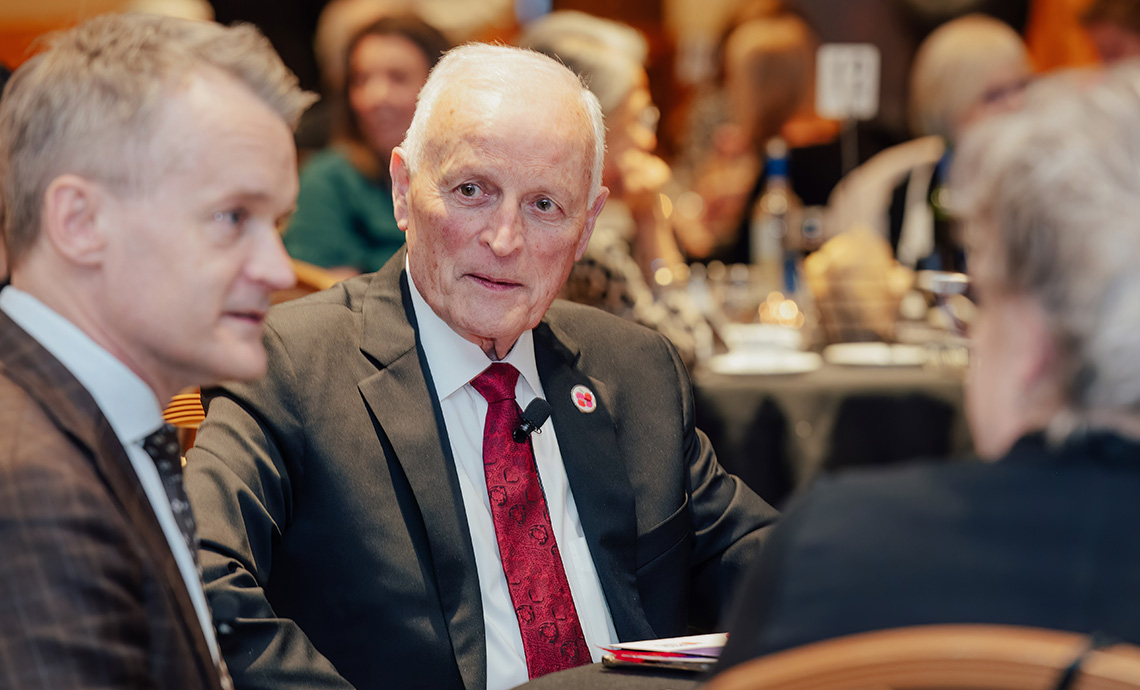
Following our recent meeting with B.C.’s Parliamentary Secretary for Seniors’ Services and Long-Term Care, RTOERO proudly submits its feedback to inform British Columbia’s 2025 provincial budget, drawing attention to the pressing and evolving needs of the province’s aging population.
In alignment with the consultation framework, RTOERO’s submission outlines three key priorities: establishing a provincial seniors strategy, expanding access to geriatric health care, and championing environmental stewardship. These recommendations aim to support a more inclusive, sustainable, and age-friendly B.C.
June 20, 2025
Select Standing Committee on Finance and Government Services
c/o Parliamentary Committees Office
Room 224, Parliament Buildings
Victoria, BC V8V 1X4
Re: RTOERO submission to British Columbia’s pre-budget consultation
To the Select Standing Committee on Finance and Government Services,
RTOERO (soon to be Entente Education Canada) is pleased to submit this feedback to help inform the consideration of B.C.’s 2025 budget.
Since 1968, RTOERO has been a voice for teachers, school and board administrators, educational support staff, and college and university faculty in their retirement. The organization’s mission is to improve the lives of its members and Canadian seniors.
The three priorities we describe here – establishing a provincial seniors strategy, expanding geriatric health care, and championing environmental stewardship – are of prime importance to RTOERO’s 84,000+ members across Canada.
In early April, we met with MLA Susie Chant, Parliamentary Secretary for Seniors, and shared these priorities with her and her team. We support the continued collaboration between the B.C. government and the independent Office of the Seniors Advocate. This body plays a key role in analyzing services for and issues facing older adults in the province. We look forward to even more progress in representing their interests.
We appreciate that at a time of uncertainty and financial pressures, it can be difficult to balance all priorities. Yet, focusing on the following three promises to contribute to a healthier quality of life for B.C. residents.
1. Establishing a provincial seniors strategy
In B.C., gaps in healthcare and social policies create barriers to seniors’ independence and to their essential role in vibrant, healthy communities across the province. A coordinated and concrete provincial strategy, crossing ministries and services, would strengthen support for seniors. As the Office of the Seniors Advocate has called for, such a strategy would have clear targets and performance measures.
Seniors are B.C.’s fastest growing demographic. About 1 in 5 British Columbians are now aged 65 or older. In a decade, that will be almost 1 in 3. Today’s seniors are living longer and healthier lives. They play a major role in serving their communities through continued work, volunteering, civic engagement and charitable donations.
Beyond expanding health care for seniors (see priority #2), a provincial seniors strategy could help address the critical issue of aging at home. A national survey found that 78% of Canadians want to age in their current homes, but just 26% feel they’ll be able to.
Challenges around health, mobility, safety and finances can derail the dream of aging in place. In many cases, it is difficult for adults over age 65 to live at home when the costs of equipment and remodelling living quarters for health issues are unaffordable. Yet long-term care, where people often go reluctantly, can cost far more both financially and emotionally.
Health care already accounts for more than 40% of B.C.’s operating expenses. We know that health care costs increase on the continuum from home care to long-term care (LTC) to acute care. We also know across Canada almost nine in 10 health care dollars go towards institutional care. As a country, we spend significantly less on home and community care (HCC) than the OECD average.
LTC, where people often go reluctantly, can be stressful and bring an emotional cost to seniors who would have preferred to remain in their familiar surroundings. Then there’s the actual financial cost – a home support review once found that an LTC bed in B.C. costs taxpayers almost $28,000 more per year than just two hours of daily home support.
The Office of the Seniors Advocate has said that 15% of LTC residents could be living in the community, with the right support. Yet unmet demand for home support services in B.C. (along with the increase in the population of seniors) has led to expanding wait lists for long-term care.
For older residents of B.C., managing their health care must start before situations become acute. Successful home-care programs remove a considerable burden from long-term and acute care services. In fact, community-based solutions are key to solving the crisis in long-term care.
B.C. does have many key programs to assist with aging in place, like rebates for accessible home adaptations, a home renovation tax credit for seniors, rent subsidies, and funding for non-medical home support services. Yet they often fall short.
A provincial seniors strategy can help to add to such supports, and also to ensure the right framework for care. With proper teams skilled in physical and mental health, and support for home accommodation, many more older adults can continue to live where they want to be – in their own homes and communities. That’s best practice for compassionate and economic reasons.
A robust seniors strategy can also help to address other impediments, like social isolation. Connections with others keep us engaged and active. In contrast, social isolation can trigger mental, emotional and cognitive distress and worsen chronic health problems (high blood pressure, heart or respiratory disease, diabetes, etc.).
That can happen to anyone, but isolation can be a particular risk when people retire, lose a spouse, or experience decreased mobility or cognitive decline. Some studies show that upwards of 30% of seniors are in danger of becoming socially isolated.
The B.C. government should support more ways to connect seniors to family, friends, neighbours, colleagues and their communities. Reducing social isolation will have a meaningful impact on the emotional, mental and physical health of B.C.’s seniors.
It could also help to counter instances of elder abuse (physical, psychological, emotional, financial and neglect). Many older British Columbians in need of supportive services are not using them, due to lack of awareness of access.
The budget consultation document from the Minister of Finance notes the importance of making B.C.’s communities safer. The reality is that abuse and neglect of seniors is up, with reports of these incidents increasing 92% over the past five years according to Dec. 2024 Monitoring Seniors Services Report from the Office of the Seniors Advocate.
Elder abuse is a widespread yet often hidden crime, even with elevated reports. North American studies show that up to 10% of older adults will experience elder abuse each year. Translating that to B.C.’s population of seniors, it means over 100,000 residents might be at risk. We need to continue to invest in the resources that detect older people at risk, serve victims wherever they are in B.C., and raise the profile of this crime.
In addition to a made-in-B.C. action plan for seniors, the province can play a role by supporting a national seniors strategy. One with dedicated funding and accountable goals will help us to meet the growing and evolving needs of seniors.
2. Expanding geriatric health care
In B.C., as in the rest of Canada, the population is aging. Our health care systems are inadequate. They were built to deal with acute care, not with the chronic needs of seniors. Hospital-based systems don’t focus enough on home care and community-based care. It’s time to rethink how we address the rising needs of seniors.
The B.C. government should look for more ways to support health standards for older adults in a holistic way. Such standards will guide health care practices for aging – around mind, body and spirit – and establish robust accountability models.
Services and policies for seniors often focus on physical health. That’s vital, but healthy aging also encompasses active lifestyles, social inclusion, mental health, age-friendly communities and coping with change.
We need to evaluate how older adults are faring across all wellness dimensions, and provide resources/programs to support that healthy aging. In addition, health care standards must govern aging concerns along the pipeline and all networks within it.
The B.C. government has noted that continued investment in the province’s Health Human Resources Strategy will train more health-care workers. One area in particular that’s in dire need is geriatrics training.
Canada faces a shortage of geriatricians. There are only about 375 geriatricians working in Canada (about one for every 17,500 seniors), and almost half of those are in Ontario. That’s unacceptable if our senior population is to age with dignity and receive the best health care.
The availability of appropriate health, social and community care providers – including geriatricians – supports healthy aging. We don’t invest enough in geriatric care training.
We want to see special post-graduate programs and diplomas to help create careers in geriatrics for health care and psychosocial service workers.
While governments look for ways to invest in and attract more family doctors, a broader pool of geriatricians for B.C. will also play a vital role in helping older adults remain healthy and independent for as long as possible.
Moreover, a wide range of health care professionals need increased training on serving the seniors population. Basic education and training relevant to geriatrics and gerontology should be essential in any health care or psychosocial program. It’s vital to improve the pipeline of these health-care workers.
Lastly, the number of seniors, and longer lifespans, are creating multiple pressures on LTC. There’s a shortage of spaces, a shortage of personal support workers, and those arriving in LTC often require more extensive support.
Across Canada, we’ve been falling short in supporting residents of LTC homes. These facilities have been understaffed, unprepared, underprotected and underserviced. Their personnel have been underpaid and underskilled.
On the publicly-subsidized side, the Office of the Seniors Advocate reported this past December that the number of seniors waiting for a bed last year increased 250% compared with five years ago.
We call for increased funding for LTC publicly-subsidized homes, for more permanent staff in LTC (and better wages, job security and benefits for them, especially sick leave), and for continued steps to improve conditions and inspections in LTC homes.
We also want to see B.C. support a national plan for LTC homes – with national standards and processes for robust accountability – and a transition to an entirely not-for-profit long-term care home model.
3. Championing environmental stewardship
Responsible use of resources, conservation, and protecting our air, land and water — improving in all areas is critical to a sustainable future. Individuals, companies, industry groups and governments all have a part to play in environmental stewardship. We need to maintain the viability of our ecosystems for ourselves, our children and grandchildren. To that end, we want to see increasing action on three areas.
Environmentally-sustainable transportation
Transportation accounts for about one-quarter of Canada’s carbon emissions. As the population and economy grow, so do the number of vehicles on our roads. B.C. has committed to reducing province-wide emissions to 40 percent below 2007 by 2030. To help meet this, B.C. has set a target to reduce transportation emissions by about one-third.
We urge the government to continue progress, whether through incentives and programs for greener transportation (private vehicles and public transit), or by working with local communities to make it easier and safer to get around without the use of a car.
Plastic pollution and recycling standards
Government of B.C. policies or incentives can help us move from a linear economy (ongoing consumption of resources) to a circular one (reusing resources). Other steps can help us to increase the recycling rate, and lower contamination rates (i.e. non-recyclable material in the recycling system).
Jurisdictions often fall short. For instance, Canadians throw away 3 million tonnes of plastic waste every year, only 9% of which is recycled. Sadly, most plastics still end up in landfills or our natural environment. The government has reported that B.C. landfills see the equivalent of more than 65 kilograms of plastic waste per person per year.
Efforts like the single-use plastic bans and updated recycling collection systems aim to make a difference, though inconsistent practices across and within provinces remain a major challenge. One hurdle to greater progress is the lack of a harmonized approach across jurisdictions. Moving forward, the government also has the opportunity to take a comprehensive approach to manage the entire life cycle of plastics.
Safeguarding the water supply and drinking water
Our freshwater resources are a national treasure. Pollution and misuse threaten that. Meanwhile, while urban centres enjoy access to clean water, First Nations often face drinking water advisories. According to the First Nations Health Authority, as of April 30, 2025, there were 39 drinking water advisories in effect across 32 First Nation communities in B.C. (14 water quality advisories, 16 boil water advisories and nine do not consume advisories).
Legislation and changes in business practices both have a role in protecting our freshwater sources and eliminating boil water orders. Beyond calling on the federal government to fulfill its responsibility, B.C. can also play a part in supporting upgraded water systems and alleviating the drinking water crisis in the province’s First Nations communities.
Sincerely,
John Cappelletti, Chair of the Board
Jim Grieve, CEO
RTOERO is a bilingual trusted voice on healthy, active living in the retirement journey for the broader education community. With 86,000+ members in 51 districts across Canada, we are the largest national provider of non-profit group health benefits for education retirees. We welcome members who work in or are retired from the early years, schools and school boards, post-secondary and any other capacity in education. We believe in a better future, together!